
Reviewed · CAESAREA AND ACRE TOURS
Unforgettable Tour to Caesarea, Haifa, Acre and Rosh HaNikra from Tel Aviv
Four major stops, one long day. This northern Israel tour links Roman ruins, Baha’i gardens, Crusader-era Acre, and the sea caves of Rosh HaNikra in a single guided outing from Tel Aviv. I like the mix of ancient sites and coastal scenery, and I like that hotel pickup, transport, guiding, and entrance fees are bundled into the $155 price. The main drawback is the pace: ten hours is a lot of time on the road, and some stops feel more like a carefully managed overview than a relaxed visit.
I also like the chance to reach Rosh HaNikra without arranging your own transport. The cable car down to the limestone grottoes is the day’s most unusual experience, while Caesarea gives you the strongest Roman setting. You should know, though, that Haifa may be a brief viewpoint stop rather than a full visit to the Baha’i Gardens, and the tour can be conducted in two languages.
The tour begins early, with pickup around 6:40 a.m., and may include up to 40 people. Several guides, including Aviva, Itamar, Rom, Abraham, Norbert, and Sivan, have earned praise for clear storytelling, humor, and professionalism. Still, guide quality can vary, so the experience depends heavily on who leads your departure and how well the group stays on schedule.
In This Review
- Key points to know before booking
- Why this northern coast day trip works
- The 6:40 a.m. start and the long ride north
- Caesarea’s Roman harbor and amphitheater
- Haifa and the Baha’i terraces
- Rosh HaNikra’s cable car and sea caves
- Walking through Acre’s Old City
- Guiding quality can make or break the day
- Is $155 good value for a ten-hour day?
- Who should book this tour?
- Final verdict: a strong overview with a fast pace
- FAQ
- How long is the tour?
- What time does pickup begin?
- Is hotel pickup included?
- Which places does the tour visit?
- Are entrance fees included?
- Is the Rosh HaNikra cable car included?
- Is food included?
- Can children join the tour?
- How many people can join the tour?
- Are the Baha’i Gardens open every day?
- What is the cancellation policy?
Key points to know before booking
- Caesarea gives you the best Roman stop: See the amphitheater, hippodrome remains, gateways, moat, walls, and excavated rooms in about an hour.
- Rosh HaNikra is the visual highlight: A cable car carries you down to wave-carved limestone grottoes near Israel’s northern border.
- Haifa is mainly a scenic viewing stop: You may see the Baha’i Shrine and terraces from above rather than walk through the gardens.
- Acre packs several eras into a short visit: The Old City and citadel connect Crusader, Ottoman, and British Mandate history.
- The day is efficient but demanding: Expect early pickup, walking, heat, and limited time for meals and rest.
- The $155 price buys convenience: Hotel transfers, a guide, an air-conditioned vehicle, and entrance fees are included, but food, drinks, and insurance are not.
Why this northern coast day trip works

Israel’s northern coast rewards visitors who enjoy variety. In one day, you move from the Roman age to the modern Baha’i faith, then on to Crusader Acre and a natural site shaped by the Mediterranean Sea. You are not simply visiting four similar museums. Each stop has a different mood and a different reason to be there.
That variety is the tour’s greatest strength. If you have only a few days in Israel, this is an efficient way to see places that are awkward to combine independently from Tel Aviv. You get a guide to explain the broad sweep of local history, a driver to handle the long distances, and transport back to your hotel at the end.
The tradeoff is depth. A ten-hour schedule cannot give Caesarea, Haifa, Acre, and Rosh HaNikra the time they each deserve. I would choose this tour for a first look at the north, not as the final word on any one location.
More coastal runs to Caesarea and Acre:
- From Tel Aviv: Caesarea, Haifa and Akko Day Trip
★ 4.4 · 744 reviews - Caesarea, Rosh Hanikra and Acre Day Trip from Tel Aviv
★ 4.5 · 406 reviews - Walking Tour of Akko (Half-day)
★ 5.0 · 84 reviews
The 6:40 a.m. start and the long ride north
Pickup begins early, around 6:40 a.m. The exact arrangement is door-to-door hotel pickup and drop-off, using an air-conditioned vehicle. That is a major help in Israel’s heat, especially when you are visiting several open-air sites in one day.
The group can reach 40 people, so this is not a private or intimate outing. A larger group can make boarding and regrouping slower, particularly at busy stops. One account also described a transfer at a parking area, with a wait for another bus, so you should be prepared for the possibility that the transport plan may involve a vehicle change.
That point matters because every minute counts on a schedule this full. One departure was also reported to use two languages, which reduced the amount of time available for explanations. If you prefer detailed guiding in one language, confirm that before booking.
Bring water, sun protection, and shoes suitable for walking. Food and drinks are not included, and one especially useful piece of advice from the tour feedback is that the day can feel hot and tiring. The schedule includes stops, but it does not promise a dedicated lunch break or regular water service.
Caesarea’s Roman harbor and amphitheater
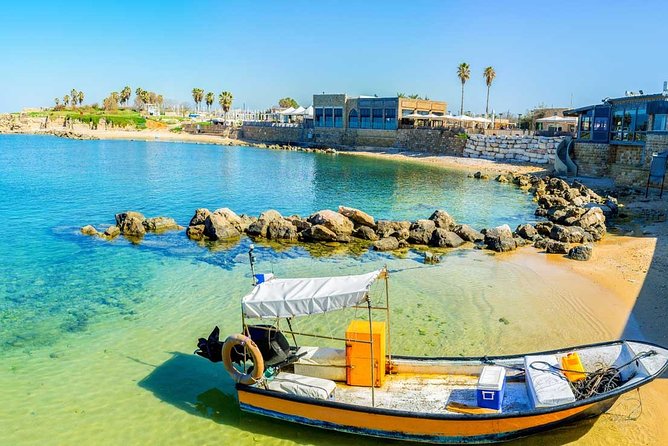
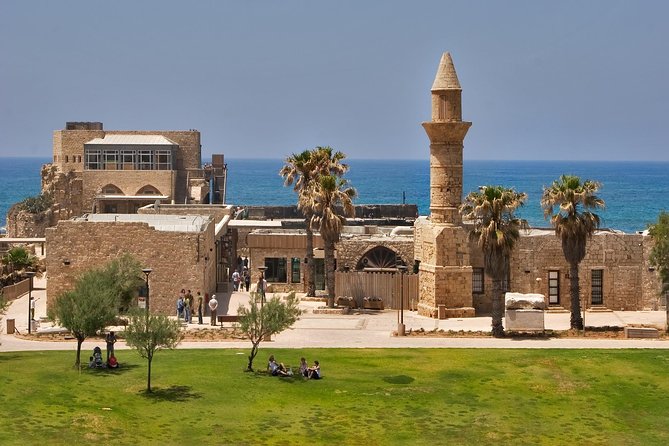
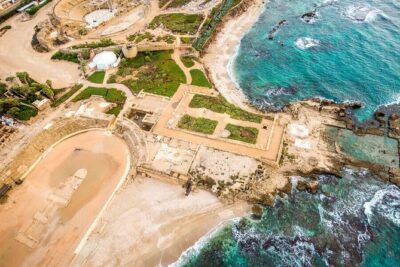
Caesarea is the day’s first major stop and one of its best. Herod the Great built the city and named it for Caesar, creating a wealthy port with Roman ambition on the Mediterranean coast. The ruins show the scale of that project even when viewed in a compact one-hour visit.
You can see gateways, a moat, sections of city walls, and excavated rooms. The Roman amphitheater is the clearest focal point. It remains well preserved and still hosts performances, which gives the stone structure a useful connection to present-day Israel rather than leaving it as a silent ruin.
Near the amphitheater are remains of the hippodrome, where chariot races once took place. Your guide can help you picture the crowds, public spectacles, and civic pride that made Caesarea important. Without that context, the site can look like scattered stones. With it, the amphitheater and racecourse become evidence of a planned, prosperous Roman city.
I would give Caesarea your full attention. It has strong visual appeal, easy-to-understand monuments, and a clear story. The limitation is time. One hour is enough for an introduction and photographs, but not for a slow archaeological visit or every corner of the park.
Wear a hat and use sunscreen here. Much of the experience takes place outdoors, and the heat can build quickly. This is also one of the places where a good guide makes a real difference. Sivan, who has an archaeology background, was praised for explaining how excavations reveal the past. Other guides, including Abraham and Rom, were praised for bringing the site to life through storytelling.
Haifa and the Baha’i terraces
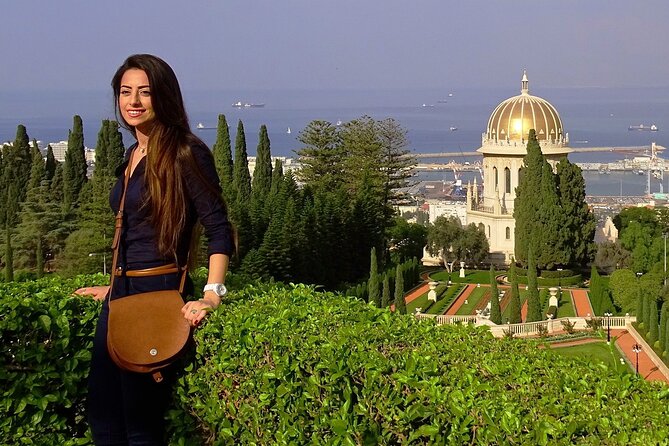
The drive continues through Haifa, where the tour stops to view the Baha’i Shrine and Gardens. The gardens descend in 19 terraces toward the city, with carefully arranged flowers and formal designs spread across the mountainside.
From an upper viewpoint, the scene is striking. You get a broad look at Haifa and the Mediterranean, along with the symmetry of the terraces. This is a good place for photographs and a short explanation of the Baha’i faith and the importance of the shrine.
You should set your expectations carefully. The scheduled visit is only about 20 minutes, and the experience may be a viewing stop rather than entry into the gardens. One important practical detail is that the gardens are closed on Mondays and Tuesdays, according to tour information. If seeing the terraces from inside is a priority, check the operating schedule and confirm exactly what your departure includes.
This is the weakest stop for anyone expecting a full garden visit. The tour title and description can make Haifa sound like a major exploration, but the actual time is brief. I would treat it as a scenic introduction, not a substitute for a dedicated Haifa tour.
Still, the stop earns its place in the itinerary. It breaks up the ruins with a modern religious site and gives you a sense of Haifa’s position between mountain and sea. Just do not count on wandering through all 19 terraces.
More Tel Aviv tours worth comparing
- From Tel Aviv: Masada & Dead Sea Full Day Tour with Pick Up
★ 4.5 · 1,496 reviews - From Tel Aviv: Jerusalem and Bethlehem Guided Day Trip
★ 4.3 · 1,316 reviews - Masada and the Dead Sea Day Trip from Tel Aviv
★ 4.5 · 1,014 reviews - Tel Aviv: Jerusalem, Bethlehem & Dead Sea
★ 4.0 · 881 reviews
Rosh HaNikra’s cable car and sea caves
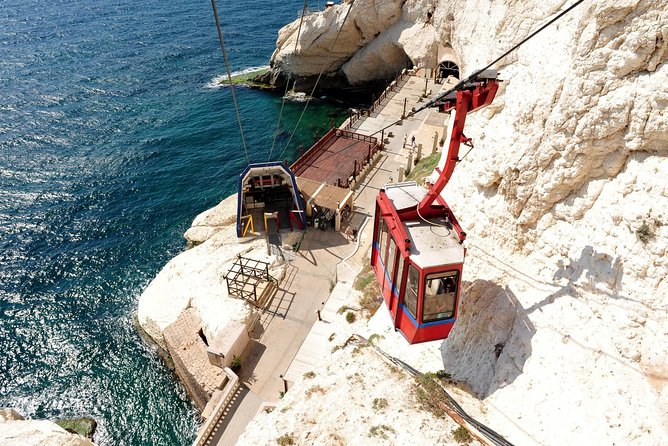
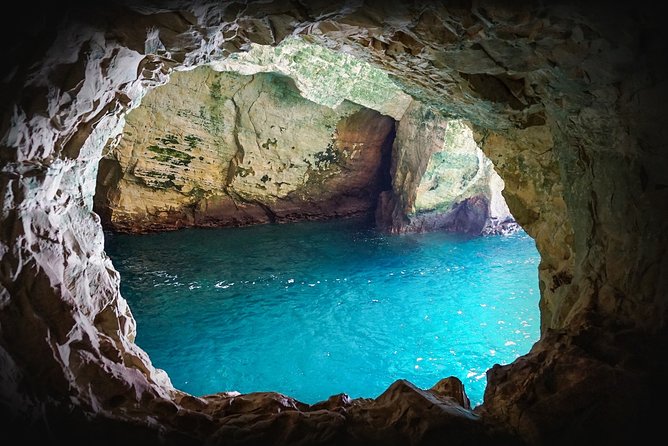
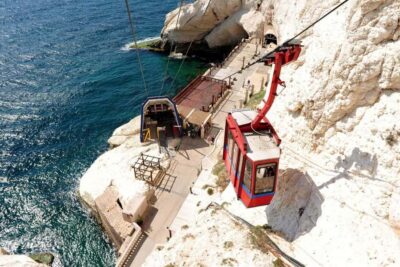
Rosh HaNikra is likely to be the day’s most memorable stop. At Israel’s northernmost point on the Mediterranean coast, waves have carved passages and chambers into the pale limestone. The tour takes you down by cable car, turning the arrival itself into part of the attraction.
Inside the grottoes, you follow the paths through a watery world shaped by constant wave action. The sound of the sea, the pale rock, and the tight passages create a very different experience from the open ruins at Caesarea. This is the stop that gives the day its strongest natural element.
The visit is divided into time at Rosh HaNikra and time exploring the grottos near the Lebanese border. Together, you have roughly 1 hour and 40 minutes connected to the site. That is enough to ride the cable car, walk through the main areas, and take photographs, though conditions and crowd flow can affect how long you spend in each section.
The border setting also adds context. You are visiting a dramatic coastal point close to Lebanon, not just a scenic cave attraction. It is a useful reminder that geography and modern borders remain part of the northern coast’s story.
Bring shoes with a reliable grip and keep your camera ready. The tour information does not promise specific weather or sea conditions, so the visual experience can vary. Still, the Mediterranean views and the unusual cable-car descent make Rosh HaNikra the stop I would least want to miss.
Walking through Acre’s Old City
Acre, also called Akko, brings the tour back to urban history. Its Old City has been shaped by Crusader, Ottoman, and British periods, and the compact setting lets you move among layers of the past without covering a huge distance by vehicle.
The one-hour Old City visit gives you a short introduction to the streets, walls, and historic character of Acre. The tour also includes the citadel, where the remains of Crusader buildings connect with later use under Turkish rule.
The citadel is not only a medieval site. It also includes the prison used during Ottoman rule and the gallows used under the British Mandate. Those gallows recall the British restrictions on Jewish immigration to Palestine after World War II and the Jewish prisoners who were executed for breaking those laws. This is a serious, difficult part of the visit, but it helps explain why Acre matters to modern Israeli history as well as medieval history.
The tour description identifies Acre and Haifa among the UNESCO-related highlights, but you should not expect a long, detailed study of Acre’s heritage in one hour. The stop is best understood as a compact introduction to the Old City and citadel. If you enjoy Crusader architecture or Ottoman history, you may want a separate visit with more time.
Acre can also be the point where fatigue catches up with you. By this stage, you have been on the road since early morning and have already visited several outdoor sites. Keep your pace comfortable and stay close enough to hear the guide.
Guiding quality can make or break the day

The strongest praise for this tour centers on the guides. Aviva was described as funny and engaging. Itamar was praised for making the border area more personal through his military background and local connections. Rom, Abraham, Norbert, and Sivan were also singled out for warmth, organization, historical explanation, or archaeology-based insight.
That range of feedback tells you what to value. A strong guide can connect Roman engineering, Baha’i religious practice, Crusader rule, Ottoman prisons, British policy, and modern borders into one understandable story. The day covers a large amount of material, so clear explanations matter more than a constant stream of facts.
The less positive experiences point to two risks. Some departures may be bilingual, cutting explanation time nearly in half. One guide was described as overly strict and unpleasant with the group. You cannot choose the guide from the information provided, so book this as a group tour with variable guiding style, not as a guaranteed private lecture.
Professional drivers and punctual transport were also praised on several departures. That matters on a route with four major destinations. A late start, long vehicle change, or slow group can reduce time at the final stops.
Is $155 good value for a ten-hour day?

At $155, the tour is not the cheapest way to see northern Israel, but the price covers several useful costs: hotel pickup and drop-off, an air-conditioned vehicle, a professional guide, and entrance fees. Rosh HaNikra’s cable car and grotto access are especially valuable to have arranged in advance.
You are paying for reach and simplicity. Without a car, visiting Caesarea, Haifa, Acre, and Rosh HaNikra in one day would require careful planning and multiple transport connections. The tour removes that work and lets you focus on the sites.
The value is lower if you want long visits, independent wandering, or a proper meal built into the schedule. Food and drinks are extra, insurance is not included, and the day may not provide enough rest for everyone. I would also factor in the possibility of a larger group and a bilingual guide.
For a short Israel trip, the price is reasonable if your main goal is coverage. For a longer stay, you may get more from choosing one or two destinations and giving them more time.
Who should book this tour?
I would recommend it to first-time visitors based in Tel Aviv who want a broad view of the north without renting a car. It suits people who enjoy history, scenic stops, guided context, and a full schedule. Families can participate from age four, though younger children may find the early start and long day tiring.
It is also a good fit if Rosh HaNikra is high on your list. The cable car and grottos are not easily folded into a casual Tel Aviv day, and the tour handles the distance for you.
I would hesitate if you dislike group travel, need frequent breaks, or want to enter the Baha’i Gardens. I would also think twice if you are sensitive to heat or expect a leisurely lunch. The tour covers a lot, but it asks you to keep moving.
Book at least 24 hours ahead if your plans could change. Cancellation is free up to that point, while cancellations or changes inside 24 hours are not refunded or accepted. Confirm the pickup and return location carefully, since one departure ended at a different point from the original pickup.
Final verdict: a strong overview with a fast pace
This is an ambitious day trip with a worthwhile mix of Roman ruins, religious architecture, coastal nature, and Acre’s layered past. Caesarea and Rosh HaNikra are the strongest anchors, while Haifa is more limited and Acre depends on how much context your guide provides.
I would book it if you have limited time and want the northern coast handled in one organized day. I would skip it in favor of slower, separate visits if you want full access to Haifa’s gardens, an unhurried Acre walk, or substantial time at each archaeological site.
FAQ
How long is the tour?
The tour lasts approximately 10 hours.
What time does pickup begin?
The listed start time is 6:40 a.m.
Is hotel pickup included?
Yes. Hotel pickup and drop-off are included.
Which places does the tour visit?
The tour visits Caesarea National Park, the Baha’i Gardens area in Haifa, Rosh HaNikra and its grottos, the Lebanese border area, Acre’s Old City, and the Citadel of Acre.
Are entrance fees included?
Yes. The tour includes entrance fees.
Is the Rosh HaNikra cable car included?
The tour includes access to Rosh HaNikra and its grotto experience, with entrance fees included in the package.
Is food included?
No. Food and drinks are not included.
Can children join the tour?
Yes. The minimum starting age is four years old.
How many people can join the tour?
The maximum group size is 40 people.
Are the Baha’i Gardens open every day?
The supplied tour information notes that the Baha’i Gardens are closed on Mondays and Tuesdays. The Haifa stop may also be a viewpoint visit rather than entry into the gardens.
What is the cancellation policy?
You can cancel at least 24 hours before the start time for a full refund. Cancellations and changes made less than 24 hours before the tour are not accepted, and the amount paid is not refunded.
Recently listed in Tel Aviv
- Wine Tour North of Israel from Tel Aviv★ 5.0 · 2 reviews
- Private wine tour of Northern Israel★ 5.0 · 4 reviews
- private Full-day Tour to Jericho + the Dead Sea★ 5.0 · 3 reviews
- private Full-Day Tour to Bethlehem and Jerusalem★ 5.0 · 2 reviews
- Package VIP Skip Line Services in BGN Airport with Transfer to Tel aviv Hotels★ 5.0 · 3 reviews
- Jerusalem and Dead Sea Trip from Tel Aviv★ 4.0 · 6 reviews
- Private Transfer from Ben Gurion Airport to Tel Aviv, Bat Yam, Rishon LeZion★ 5.0 · 2 reviews
- VIP Tel Aviv airport Terminal 3 Fast Track Skip Line From plane★ 4.5 · 9 reviews
Caesarea and Acre Tours, compared.
Caesarea, Rosh Hanikra and Acre Day Trip from Tel Aviv
Read our review →
Caesarea, Acre & Rosh Hanikra Day Trip from Jerusalem
Read our review →
Tel Aviv/Jerusalem: Caesarea, Haifa & Akko Day Tour
Read our review →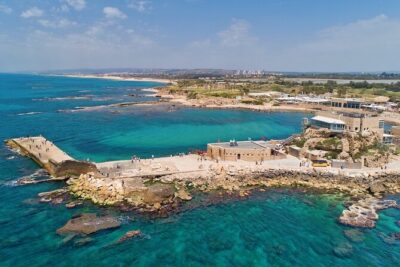
Browse the lists this tour appears in