

Reviewed · WALKING TOURS
Jerusalem Jewish Orthodox Neighborhood Walking Tour
See Jerusalem from the inside. This walking tour offers a rare look at Haredi life in Me’a She’arim, with stops at a synagogue, bakery, community spaces, and a local library. I like the direct cultural access, especially the chance to hear about religious customs from a guide connected to the community. I also like the food stop, where rugelach and challah give the tour a tasty local touch.
The main drawback is inconsistent timing and content. The tour is described in different places as lasting about two and a half hours, three hours, or four hours. The family visit, synagogue access, pastries, and other promised stops may also vary, so you should confirm exactly what will happen before booking.
In This Review
- Key points to know before you go
- Starting at Davidka Square at 4:30 pm
- Entering Me’a She’arim with the right attitude
- Synagogue access may be more limited than expected
- A bakery stop with rugelach and challah
- The family visit is the most personal part
- Community center, soup kitchen, and local charity
- Ancient artifacts inside a neighborhood library
- A Hasidic tomb and the neighborhood’s sacred places
- Is $45 a fair price?
- The duration needs careful checking
- Who will get the most from this walk?
- Booking, clothing, and cancellation advice
- Should you book the Jerusalem Jewish Orthodox Neighborhood Walking Tour?
- FAQ
- Where does the tour begin?
- Where does the tour end?
- How long does the tour last?
- What neighborhood does the tour visit?
- Is modest clothing required?
- Are food and drinks included?
- What is the maximum group size?
- Can I cancel for a refund?
Key points to know before you go
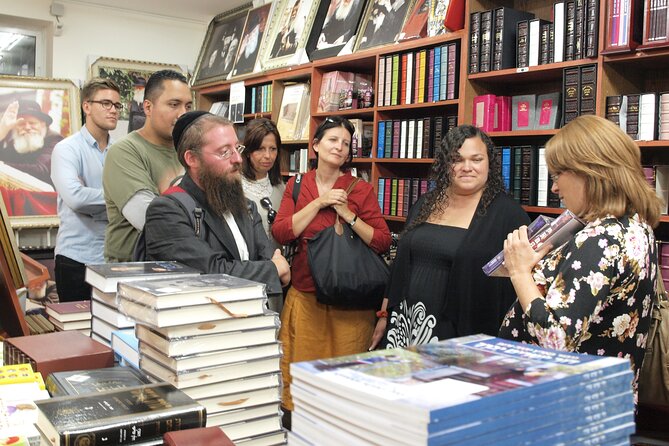
- Me’a She’arim from a local perspective: Walk through one of Jerusalem’s best-known Haredi neighborhoods with a guide who can explain signs, customs, clothing, and religious practice.
- A tour built around daily life: The focus is not only on monuments. You may visit a working synagogue, community center, soup kitchen, bakery, and neighborhood library.
- A personal welcome may be possible: The experience is designed to include a visit with a Haredi family, though this has not happened on every departure.
- Food is part of the lesson: Rugelach and challah help you connect religious traditions with ordinary family and community life.
- Dress matters: Men and women must wear modest clothing. This is a requirement, not a casual suggestion.
- Small-group format: The maximum group size is 20 people, which should make it easier to ask questions and hear the guide.
Starting at Davidka Square at 4:30 pm
The tour begins at Abraham Jerusalem, on Ha-Nevi’im Street 67, at 4:30 pm. From there, the route heads toward Davidka Square, a useful meeting point near public transportation, the light rail, Jaffa Road, and Mahane Yehuda Market.
Davidka Square is not the star of the tour, but it gives you a helpful starting point. The square takes its name from the Davidka, a homemade mortar used by Jewish forces during the 1948 Arab-Israeli War. A short stop here connects modern Jerusalem with the city’s wartime past before you move into the more focused subject of Haredi community life.
You can expect about 15 minutes at the square. Admission is free, and there is no separate ticket to buy. Since the tour ends back at the meeting point, you do not need to arrange a second pickup location.
The late afternoon start also makes practical sense for a walking tour. Still, Jerusalem’s weather can change, and the activity may be canceled in poor weather. Wear comfortable shoes and bring water, even though the tour itself is not especially long.
More Walking Tours in Jerusalem
- Jerusalem: Guided Walking Tour of the Old City
★ 4.7 · 386 reviews - All Inclusive Walking Tour Old City Jerusalem
★ 5.0 · 83 reviews - Jerusalem Walking Tour: In the Footsteps of Jesus
★ 4.5 · 67 reviews
Entering Me’a She’arim with the right attitude
Me’a She’arim is the heart of the experience. The neighborhood is home to Haredi, or ultra-Orthodox, Jewish communities whose religious practices shape almost every part of daily life. A guide from the local community can help you read the streets in a way you could not manage alone.
You may notice religious signs, modest clothing, distinctive customs, and public notices that reflect the neighborhood’s rules and concerns. Your guide should explain these details rather than simply point at them. That difference matters. Without context, it is easy to treat the neighborhood as a curiosity. With a good guide, you begin to understand how religion influences education, family life, charity, work, and community organization.
The walking portion through Me’a She’arim is listed as about 1 hour and 15 minutes. That is enough time for a useful introduction, though not enough to cover every part of the community. Expect frequent stops for explanation and questions rather than a fast march from one landmark to another.
This is where the best guides make the largest difference. Motti is specifically associated with especially clear explanations and thoughtful answers. Another guide described for the experience has been praised for offering a fair view of this part of Israeli society. I would value that balance. Haredi life can be misunderstood by outsiders, and a guide who explains both its appeal and its challenges will give you a more useful picture than a guide who presents only a polished version.
Synagogue access may be more limited than expected
A working synagogue is listed among the main stops. That can be a meaningful part of the visit because a synagogue is not simply a historic building in this setting. It is a living center for prayer and community life.
You should also prepare for limited access. On at least one reported departure, the group viewed the synagogue through a window rather than entering. That may have been due to local rules, timing, or community preference. The point is simple: do not book this tour solely because you expect a full interior visit.
The same principle applies throughout Me’a She’arim. You are entering an active residential community, not an open-air museum. The most respectful approach is to listen, dress appropriately, avoid treating residents as photo subjects, and follow your guide’s directions.
Modest dress is required for both men and women. The tour information does not give exact measurements for sleeves, hemlines, or head coverings, so ask the operator before arrival if you are unsure. Dressing conservatively is the safest choice.
A bakery stop with rugelach and challah
The bakery visit is one of the most appealing parts of the tour. Food gives you an easy way into a subject that can otherwise feel abstract. Rugelach, the small rolled pastry often filled with chocolate or cinnamon, and challah, the braided bread associated with Jewish Sabbath meals, connect religious customs with the pleasures of the table.
The food is also a useful reminder that Haredi neighborhoods are communities where people shop, eat, work, raise children, and care for one another. A bakery says as much about ordinary life as a synagogue does.
There is a catch. Food and drinks are not included in the tour price. One reported experience involved buying food at a snack shop separately, rather than receiving included pastries. If the bakery sample is important to you, confirm whether the tasting is included, optional, or replaced by a stop where you pay on your own.
Even with that uncertainty, I like the idea behind the food stop. It gives the guide a natural chance to explain holiday foods, family meals, charitable food programs, and the role of neighborhood businesses.
A different day out, same base:
- From Jerusalem: Masada & Dead Sea Full Day Tour with Pick Up
★ 4.5 · 815 reviews - Masada and the Dead Sea Day Trip from Jerusalem
★ 4.5 · 757 reviews - From Jerusalem: Nazareth and Sea of Galilee Tour
★ 4.5 · 588 reviews - Nazareth and the Sea of Galilee Day Trip from Jerusalem
★ 4.5 · 446 reviews
The family visit is the most personal part
The planned home visit is potentially the most valuable feature. Meeting a Haredi family in its own home could offer a more human picture of religious life than a street walk alone. You may be able to ask about family routines, community ties, education, religious practice, and the practical choices that shape daily life.
But this is also the feature that needs the clearest confirmation. A family visit did not take place on every reported departure. The reasons are not provided, and privacy or scheduling may affect whether it happens.
I would treat the home visit as a possible highlight, not a guarantee. If you are mainly interested in personal conversation, ask before paying whether a family visit is confirmed for your date. If it is not, decide if the neighborhood walk and guide discussion still offer enough value.
That flexibility is important because the experience can be worthwhile without entering a private home. Still, the difference between a street explanation and a personal welcome is substantial. The operator should be clear about what is scheduled.
Community center, soup kitchen, and local charity
The tour also includes a community center and a soup kitchen in its stated program. These stops can add needed depth. They show how the neighborhood supports its residents and how religious values are put into practice through local services.
A soup kitchen is especially useful in this context because it shifts the focus from clothing and architecture to social responsibility. You get a chance to see how charity functions as part of community life, rather than as an occasional activity for visitors.
The information provided does not describe the exact format of these stops. You may enter the facilities, hear an explanation from outside, or pass them during the walk. Ask your guide what is possible on the day, and do not assume that you will volunteer, eat a meal, or tour every room.
Ancient artifacts inside a neighborhood library
The local library is another unusual stop. It is said to house ancient Jewish religious artifacts, giving the tour a link to Jewish learning and preservation.
This may appeal to you more than a standard museum visit because the collection is presented within a neighborhood institution. You are not just looking at objects behind glass in a major tourist attraction. You are seeing how study, religious texts, and community memory fit into local life.
At the same time, the available details do not identify the artifacts or explain how extensive the collection is. Keep your expectations measured. This is likely a short interpretive stop rather than a full museum visit.
The library also helps broaden the tour. Me’a She’arim is not only about visible customs. It is also about books, study, religious authority, and the transmission of tradition.
A Hasidic tomb and the neighborhood’s sacred places
The experience includes a visit to an important Hasidic tomb. The supplied information does not name the tomb, so you should ask for the name if that site matters to you.
A tomb connected with Hasidic tradition can help explain the spiritual geography of Jerusalem. Sacred places are not always grand buildings or famous monuments. They can be tied to particular teachers, prayer traditions, and local memory.
Expect your guide to provide the meaning of the site rather than a long archaeological lecture. The value lies in learning why the place matters to the community and how religious figures continue to shape local identity.
Is $45 a fair price?
At $45 per person, the tour is reasonably priced if you receive a small-group walk with a strong local guide and several real community stops. The maximum group size is 20, which is large enough to keep the price moderate but small enough for questions if everyone stays attentive.
The value is not mainly in admission tickets. Most stops are free, and the tour includes only guided service. You are paying for access, translation, context, and the chance to enter places you might not comfortably approach on your own.
That value drops if the experience becomes only a walk around the streets. The strongest version includes the guide, synagogue access, bakery tasting, family conversation, community facilities, and library artifacts. The weaker version may last closer to three hours and offer explanations without the advertised visits.
I would consider $45 fair for the stronger version. I would be less enthusiastic if the family, food, and interior visits were all missing. Confirming the schedule before booking is the best way to protect the value.
The duration needs careful checking
The timing is the biggest practical issue. The tour summary gives an approximate duration of 2 hours and 30 minutes. The main description presents it as a four-hour experience, while the listed route adds up to about 90 minutes for Davidka Square and Me’a She’arim. A reported departure lasted about three hours.
That is a wide gap. You should not plan a dinner reservation or another evening activity immediately after the stated end time. The tour starts at 4:30 pm and returns to the meeting point, but the exact finish may depend on the group, the guide, and which stops are available.
I would allow at least four hours in your schedule. If the walk ends earlier, you can use the extra time around Jaffa Road or Mahane Yehuda Market. If it runs long, you will not be rushing.
Who will get the most from this walk?
I would recommend this experience to you if you want cultural context rather than a checklist of famous sights. It suits people who are curious about contemporary religious life, willing to ask respectful questions, and comfortable walking through a residential neighborhood.
It is also a good choice if you have already seen Jerusalem’s major historic sites and want a different angle on the city. The tour focuses on people, customs, food, religious practice, and community services.
You may want to skip it if you dislike uncertain schedules or need guaranteed access to every advertised stop. It is not the best choice for anyone expecting a conventional museum tour, a polished performance, or a fixed four-hour program with every detail locked in.
The group limit of 20 is manageable, but it is not a private tour. If you want a quiet conversation with the guide, stand near the front and ask questions during the stops.
Booking, clothing, and cancellation advice
Confirmation is provided when you book, and the tour is near public transportation. Mobile tickets make arrival simple, but you still need to reach Abraham Jerusalem at Ha-Nevi’im Street 67 by 4:30 pm.
Free cancellation is available up to 24 hours before the start time. Cancellations or changes made inside that window are not accepted for a refund. If bad weather cancels the tour, you can receive another date or a full refund. The operator also requires a minimum number of participants, so a cancellation for that reason brings the same choice of another date, another experience, or a refund.
Most people can take part, and service animals are allowed. The main physical requirement is walking for the duration of the tour, along with clothing that meets local expectations.
Should you book the Jerusalem Jewish Orthodox Neighborhood Walking Tour?
Book it if you want an informed, human introduction to Haredi Jerusalem and you can accept some uncertainty about the exact program. The best elements are strong: a local guide, direct discussion of religious customs, a bakery stop, community institutions, and the possibility of meeting a family at home.
Before you commit, confirm three things: the actual duration, whether the family visit is scheduled, and what food or synagogue access is included. If the operator gives clear answers and Motti or another strong local guide is leading, $45 can buy a revealing afternoon that goes well beyond sightseeing.
If those details remain vague, book only if the neighborhood walk and local explanation are enough for you on their own. This is a worthwhile cultural experience when handled with respect, but its value depends heavily on how much of the promised access is available that day.
FAQ
Where does the tour begin?
The tour begins at Abraham Jerusalem, Ha-Nevi’im Street 67, Jerusalem, at 4:30 pm.
Where does the tour end?
The activity ends back at the meeting point.
How long does the tour last?
The information gives several durations: approximately two and a half hours, three hours on one departure, and four hours in the main description. Confirm the expected timing before booking.
What neighborhood does the tour visit?
The main walking portion takes place in Me’a She’arim, a Haredi Jewish neighborhood in Jerusalem.
Is modest clothing required?
Yes. A modest dress code is required for both men and women.
Are food and drinks included?
No. Food and drinks are not included in the tour price. Ask whether any bakery tasting is included on your specific departure.
What is the maximum group size?
The tour can have a maximum of 20 participants.
Can I cancel for a refund?
Yes. You can cancel at least 24 hours before the start time for a full refund. Cancellations and changes made less than 24 hours before the start time are not accepted for a refund.
Recently listed in Jerusalem
- West Bank Tour from Jerusalem and Tel-Aviv – Bethlehem & Jericho★ 5.0 · 6 reviews
- Tour of Jerusalem & Dead sea private tour★ 5.0 · 4 reviews
- One-Day Tour to Bethlehem and Jericho★ 5.0 · 2 reviews
- full day tour Jerusalem price per van up to 6 people★ 5.0 · 8 reviews
- kosher Israel wine tour★ 5.0 · 4 reviews
- jerusalem classic tour★ 5.0 · 3 reviews
- Private Silk Painting Workshop in Jerusalem – Create a scarf –★ 5.0 · 4 reviews
- Experience Shabbat With Dinner In Jerusalem★ 5.0 · 5 reviews
Walking Tours, compared.


Jerusalem Walking Tour: In the Footsteps of Jesus
Read our review →

Browse the lists this tour appears in